But anyone who remembers Harry Belafonte only as the smiling entertainer with the unmistakable Caribbean voice knows just half the story.
Also interesting:
An icon with a legacy
Barbra Streisand at 84 — Her Moving Oscar Tribute to Robert Redford
He is still successful

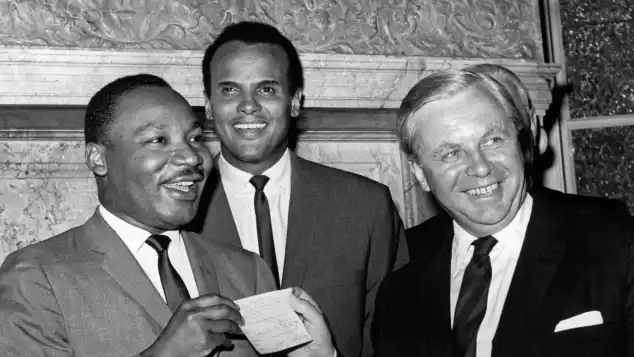
No Martin Luther King Jr. Without Harry Belafonte
The other half reveals a tireless civil rights activist—one many described as the quiet backbone of Martin Luther King Jr.’s movement. Belafonte helped finance King’s work, paid bail for imprisoned activists, supported the Freedom Riders, and ensured that Coretta Scott King and her children were financially secure after King’s assassination.
“There is no Martin Luther King Jr. without Harry Belafonte,” his biographers have often said.
From Harlem Poverty to Global Stardom
Belafonte’s story began on March 1, 1927, in Harlem. Born Harold George Bellanfanti Jr., the son of a Martinican sailor and a Jamaican laborer, he grew up in poverty. At eight, his mother sent him to live with his grandmother in Jamaica—where he absorbed the Caribbean rhythms that would later define his sound.
Back in New York by 1939, he left school at 17 and enlisted in the U.S. Navy. After World War II, he worked as a janitor. A chance encounter changed everything: a customer tipped him with theater tickets. On stage, Belafonte saw Paul Robeson—and found his calling.
He began studying acting at the New School for Social Research, alongside future stars like Marlon Brando and Walter Matthau. The path to fame had begun.
The Rise of the “King of Calypso”
In 1956, Belafonte released Calypso, the first album by a solo artist to sell over a million copies. Featuring the now-iconic "Banana Boat Song (“Day-O”)", it made him an international sensation and earned him the title “King of Calypso.” Over his lifetime, he sold more than 150 million records, placing him among legends like Frank Sinatra and Elvis Presley.
He also built an impressive acting career, starring in films such as Carmen Jones (1955), later appearing in Robert Altman’s Kansas City (1996), and, at 91, in Spike Lee’s BlacKkKlansman (2018). In 1960, he became the first Black man to win an Emmy, for Tonight with Belafonte. With multiple Grammys, a Tony Award, and an honorary Oscar in 2014, he joined the rare group of EGOT winners.
A Lifelong Fight for Justice
For Belafonte, fame was never the goal—it was a platform. He met Martin Luther King Jr. in the mid-1950s, and the two formed a deep friendship. Belafonte offered not just public support, but private, crucial backing—funding campaigns, offering his home as a safe haven, and standing by King’s family in the years after his death.
In 1985, he was instrumental in launching We Are the World, the global charity single that raised millions for famine relief in Africa. As a UNICEF Goodwill Ambassador from 1987, he continued to advocate for children and humanitarian causes worldwide. He even used his first major earnings to build a hospital for those in need.
His Lasting Legacy
Belafonte remained politically engaged well into his later years, speaking out against war, racism, and inequality. He supported progressive causes, lent his voice to social justice movements, and continued working in film into his 90s.
He was married three times, most recently to photographer Pamela Frank, whom he wed in 2008. He had four children, including actress Shari Belafonte.
Harry Belafonte died on April 25, 2023, at his home in Manhattan, surrounded by family. Three years later, his voice still echoes—through music, through history, and through the countless lives he helped shape.
His “Day-O” lives on. And so does the legacy of a man who changed far more than music.