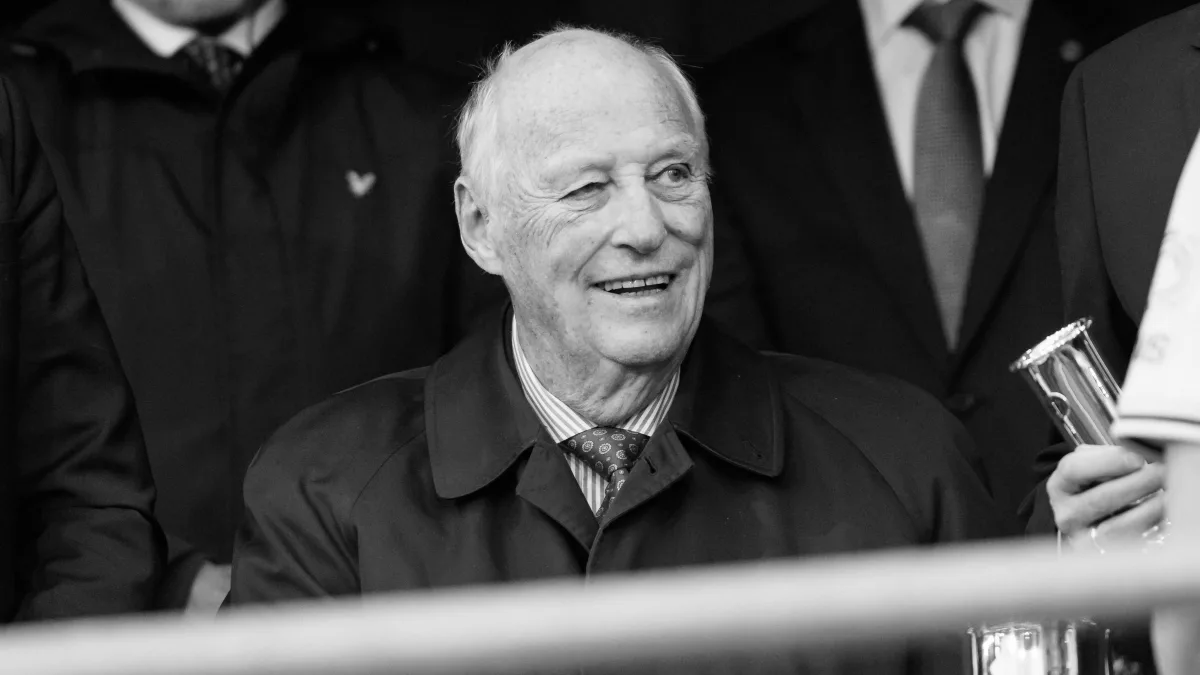
On Friday morning, August 28, 2026, King Harald V of Norway passed away at the age of 89. He died peacefully at 6:35 a.m. at Rikshospitalet in Oslo, surrounded by his family: Queen Sonja, his son Haakon, his daughter Märtha Louise, and his grandchildren.
The flag is flying at half-mast over the palace. As early as Thursday, when the seriousness of his condition became known, people began laying flowers at Slottsplassen. The following day would have marked Harald and Sonja’s 58th wedding anniversary.
King Harald V and the Speech That Moved a Nation
It was May 21 when the then-89-year-old monarch addressed his country in a video produced in complete secrecy by the Norwegian Football Association. The king announced Norway’s World Cup squad—the country was returning to the tournament for the first time since 1998.
He spoke about a team drawn from across the country, representing both large and small clubs and communities where football means so much to so many people. Then he uttered the phrase that would resonate across Norway: “We’ve waited a long time.”
Then came the names. Behind a farmer plowing a field stood Braut Haaland. A boy looked up at a red jersey bearing the name Thorstvedt. One name was written in black marker on a white football boot.
Five minutes in which an 89-year-old monarch told his people what they had to look forward to—and unknowingly created one of his final memorable moments in the public eye.
What happened next was something hardly anyone would have dared to hope for: Norway reached the quarterfinals of the 2026 World Cup for the first time ever. On July 13, the king welcomed the team to the palace. National team coach Ståle Solbakken placed a hand on Harald’s shoulder. Visibly moved, the king thanked the team for its support. It was one of the last occasions on which his country saw him this way: laughing, fully engaged, and close to the people.
What King Harald V Meant to His People
He sat on the Norwegian throne for 35 years. On January 17, 1991, he succeeded his father, Olav V, and adopted his father’s motto: “Everything for Norway.” For many Norwegians, he was more than a head of state—he was a moral authority. He visited disaster areas wearing rubber boots and, as the “Sports King,” rarely missed a major cup final.
After the far-right terrorist attack in 2011, in which 77 people were killed, he found the words that would continue to resonate for years. Speaking in a trembling voice during a televised address, he said: “Freedom is stronger than fear.” In 2016, he delivered another widely acclaimed speech calling for tolerance and acceptance of all ways of life.
Less well known is how long Harald had to fight for the right to marry the woman he loved. For nine years, the Crown Prince sought permission to marry Sonja Haraldsen, the daughter of a middle-class merchant. On August 29, 1968, they exchanged vows at Oslo Cathedral. Nearly 58 years later, she held his hand once again on Friday morning.
King Harald V: His Final Weeks at Rikshospitalet
Harald had been receiving treatment at Oslo University Hospital since August 17. The royal court initially announced that he would be on sick leave for two weeks. On Thursday, the royal household announced that his condition had become very serious.
It was not the first time the king had faced a serious health setback. In 2024, he received a pacemaker after developing an infection while on vacation, and in February 2026, he was hospitalized in Tenerife.
He never considered stepping away from his duties. Harald once said that he had sworn an oath to the Storting for life. He kept that oath until his final day.
Following King Harald V: Haakon VIII Becomes Norway’s New King
The moment his father died, Haakon became king. The 53-year-old convened an extraordinary Council of State at the palace that same morning and will henceforth be known as Haakon VIII. His wife, Mette-Marit, becomes queen, while Queen Sonja retains her title.
The new Crown Princess is 22-year-old Ingrid Alexandra, who will one day become Norway’s first reigning queen in generations.
What remains is the image of an old man who wanted to tell his country, one more time, what it had to look forward to—and who lived long enough to see that the wait had been worth it.