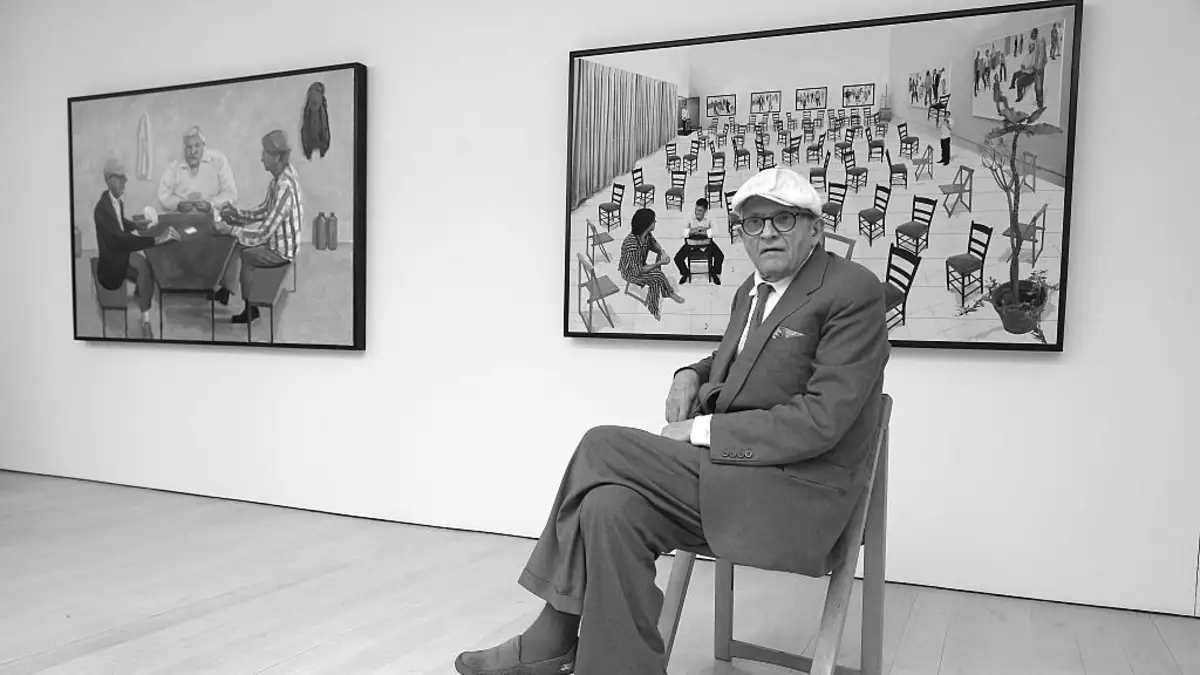
British artist David Hockney, one of the most influential figures in contemporary art, has died at 88. According to NBC News, his publicist said he passed away peacefully at home in London on Thursday, just weeks before his 89th birthday. Across seven decades, Hockney built a visual language that was instantly recognizable, from bright California pool scenes to intimate portraits and stage designs. His work blended pop sensibility, sharp observation, and bold color, giving everyday settings a polished, modern energy that still feels current.
David Hockney Built a Signature California Image
Hockney’s rise took shape after he moved to California in 1964 and shifted from abstract expressionism toward a more figurative style. That change helped produce some of his most enduring works, including “A Bigger Splash,” with its crisp geometry and sunlit poolside mood. The painting became closely tied to the image of Southern California in the public imagination. Another major work, “Portrait of an Artist (Pool with Two Figures),” later sold for $90 million at auction in 2018, briefly making it the most expensive painting by a living artist sold at the time.
Bradford Roots Shaped the Painter’s Long Career
Born in Bradford, Yorkshire, in 1937, Hockney trained first at the Bradford School of Art and later at the Royal College of Art in London. Those early years laid the foundation for a career that stretched across changing eras in British and global art. His portraits also carried major weight, including “Mr. and Mrs. Clark and Percy,” a sharply composed study of designers Ossie Clark and Celia Birtwell, and “My Parents,” painted in Bradford with a more personal focus. Together, those works showed his range beyond the pool paintings most often linked to his name.
Stage Design Added Another Layer to His Legacy
Hockney’s creative reach extended well beyond canvas. He was also a prolific designer for theater and opera, bringing his color sense and spatial precision to major productions. His stage work included Igor Stravinsky’s “The Rake’s Progress” at Glyndebourne in 1975 and Giacomo Puccini’s “Turandot” for LA Opera in 1990. That part of his career reflected the same qualities seen in his paintings: clarity, structure, and a strong feel for atmosphere. Even when working on a grand theatrical scale, his visual identity remained unmistakably his own.
Public Tributes Honor a Defining British Artist
Tributes quickly followed the news of his death. London Mayor Sadiq Khan called him a “true icon and revolutionary of British art who never stopped reinventing his work,” according to NBC News. Hockney’s publicist also said, “He smoked up to the end,” Erica Bolton told NBC News, underscoring the artist’s openly defiant stance on personal liberty. Alongside his paintings and designs, that independent streak became part of his public image. His death marks the loss of a major cultural figure whose work changed how color, light, and modern life could be seen.